
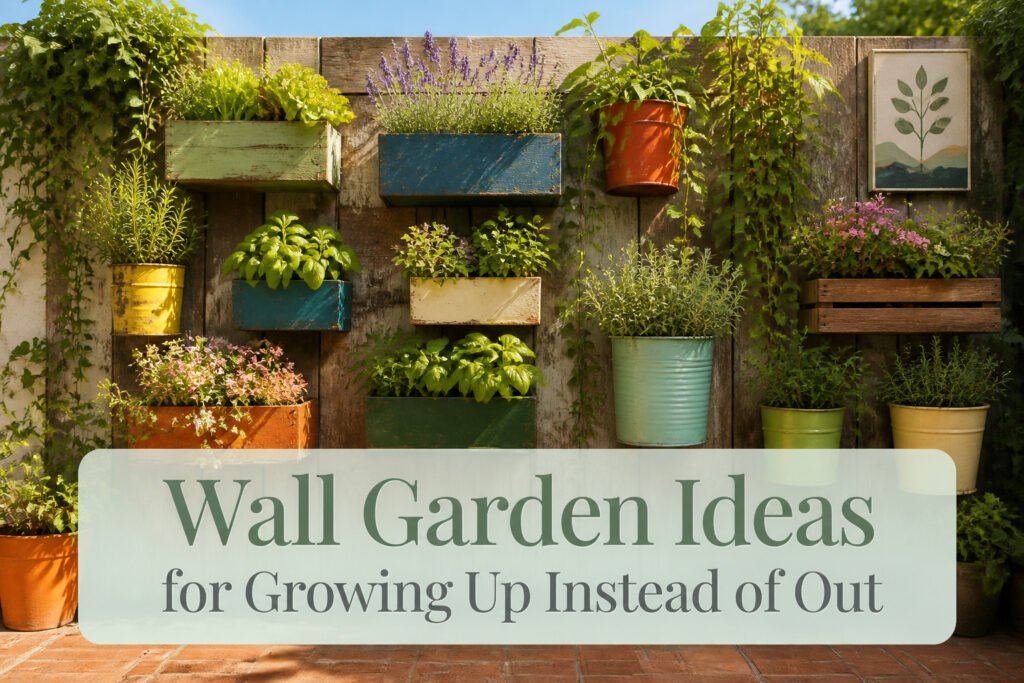
Wall gardens span from a free pallet screwed to a fence to modular living walls with built-in irrigation that cost enough to make you pause. What picks yours is how much failure you can afford to learn from. The cheap pallet lets you swap one dead herb without disassembling rows above it; the polished system punishes a single mistake with exposed plumbing and a gap that keeps getting wet. I priced the modular route for my own patio and backed away once I saw the replacement fees hidden in the module cost.
1. Vertical Herb Garden
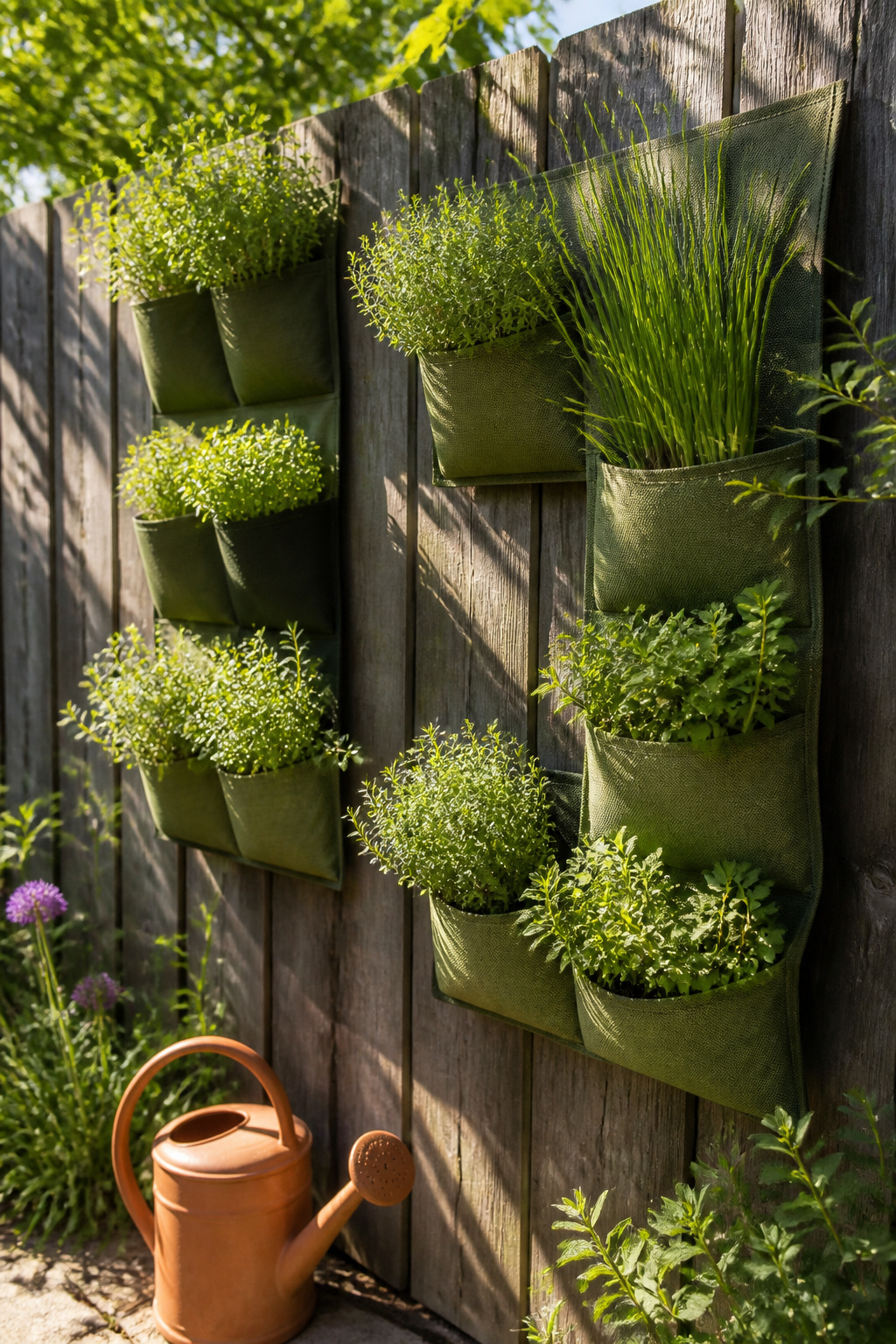
Pocket planters hang on a wall like a canvas you can eat. I tried one two summers back in a strip of afternoon sun no wider than a doormat, and thyme rooted into the fabric faster than I expected. Thyme and oregano settle in shallow pockets without complaint, and chives work if you keep them clipped so they do not flop. Strawberries will fruit there too, though they want more water than the herbs.
What stopped me cold was drainage. Water runs straight through the bottom row and out the back if the pockets sit flat against siding, so leave a gap or pick a system built to breathe. Compost in vertical planters dries from the top down and the front face both, which means the center can stay wet while the edges crisp. I learned to check with a finger two knuckles deep rather than judging by the surface.
Sun is the other hard limit. Most culinary herbs want six hours, but in a wall garden that heat multiplies. A pocket baking on brick from noon onward needs tougher stock than one on a shaded fence. If you cannot run drip irrigation, carry the watering can to every pocket, not just the ones that look dry. The middle pockets hide their thirst longest.
2. Hanging Planters
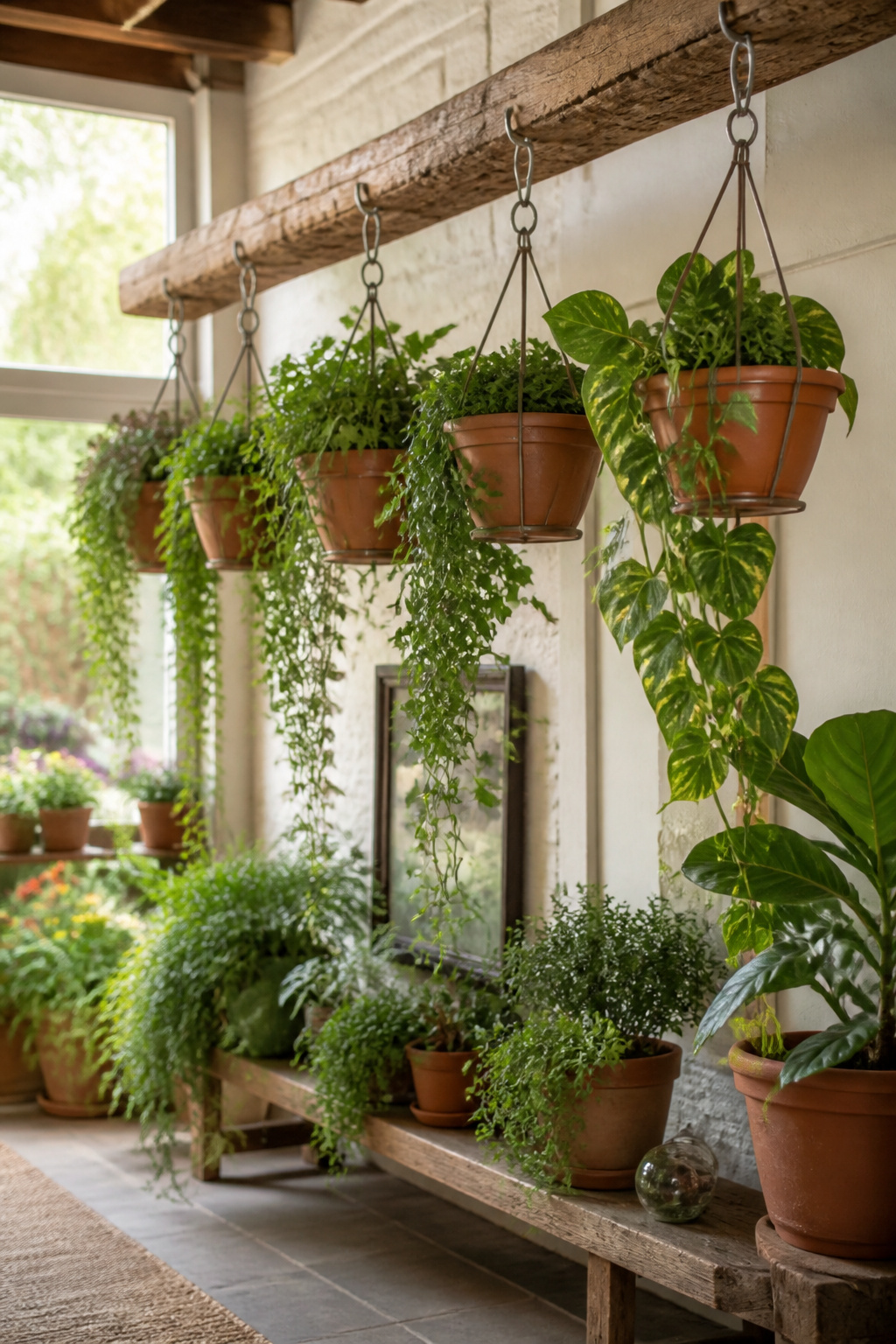
Hanging a pot from a wall or ceiling sounds simple until the hook rusts through and you find ceramic shards in the petunias. I learned that the hard way one June, which is why galvanized or stainless steel hardware is the only metal I trust now. The cheap zinc-coated hooks from the garden center lasted exactly one season before the coating failed; by August they were orange dust.
For weight, a standard toggle bolt rated for 50 pounds handles most ceramic planters filled with damp soil. If you are screwing into a stud, a 3-inch lag eye is overkill but reassuring. The real limit is the planter itself: a 1/4-inch acrylic shelf works for lightweight plastic, while 3/8-inch thickness is the safer call for terra-cotta.
Trailing plants behave differently in suspension than on a trellis. English ivy, pothos, and philodendron drop straight down without tangling into neighboring pots, which matters more than you think when a breeze comes through. I space mine at least 12 inches apart side to side and stagger heights so the lower leaves do not braid into the upper stems. Morning glory and black-eyed Susan vine climb instead of trail; save those for an arbor.
3. Trellis or Arbor for Climbing Plants
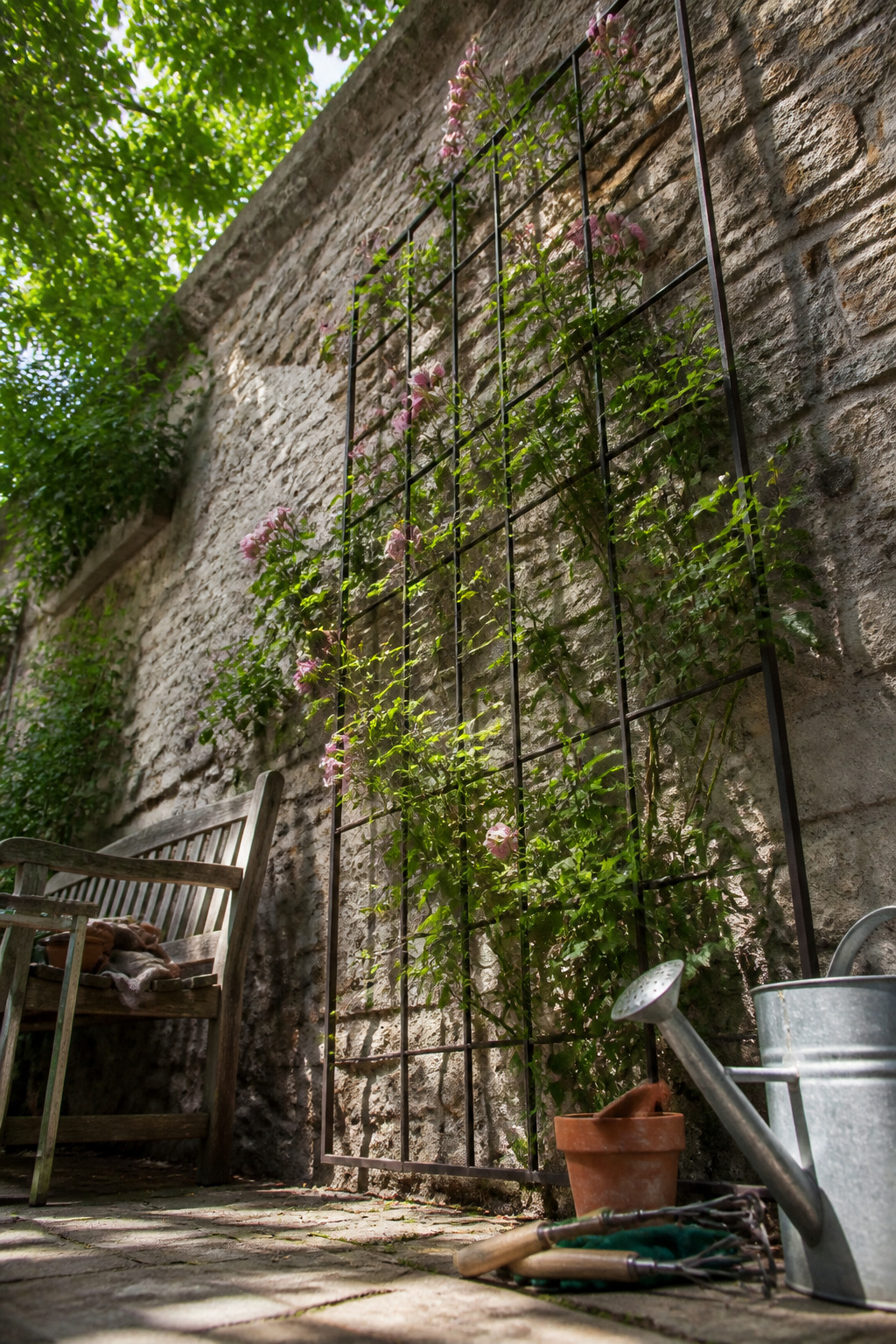
Metal arbors and wire trellises outlast wood by a decade, and the extra cost pays back the first time you skip replacing rotted posts. Set any support six to eight inches off the wall so air can move behind the foliage; tight against brick, clematis stays wet and invites the wilt that took mine two full growing seasons to outgrow. I planted a Jackmanii in 2021 and watched it wander sideways for months, tangled in its own confusion about which direction led up. The stems lean toward light, not height, so the first year I had to weave new growth upward by hand every few days. By the third spring it finally self-trained. Climbing roses, wisteria, and honeysuckle behave the same way; annual vines like hyacinth bean cover faster but die with frost and leave you bare by November. I keep one metal arbor for permanent clematis and a second set of wire panels I move around for quick summer screens.
4. Living Walls

Permanent living walls with built-in irrigation route water through a top box or drip system that feeds each module evenly. The catch is what happens when one plant in the center dies: you either leave a gap that the system keeps wetting, or you disassemble rows above it to reach the cavity. I priced one of these setups out for my own patio and backed away once I saw the cost of the modules plus the plumbing. A pallet wall took an afternoon with a drill and some screws, and when a plant fails I swap the pot without touching its neighbors. The irrigation is a watering can for now, which is enough at my scale. If your wall needs to look polished year-round, the modular system wins; if you want to learn by replacing things, the pallet pays for itself in avoided replacement fees.
5. DIY Vertical Garden Using Pallets
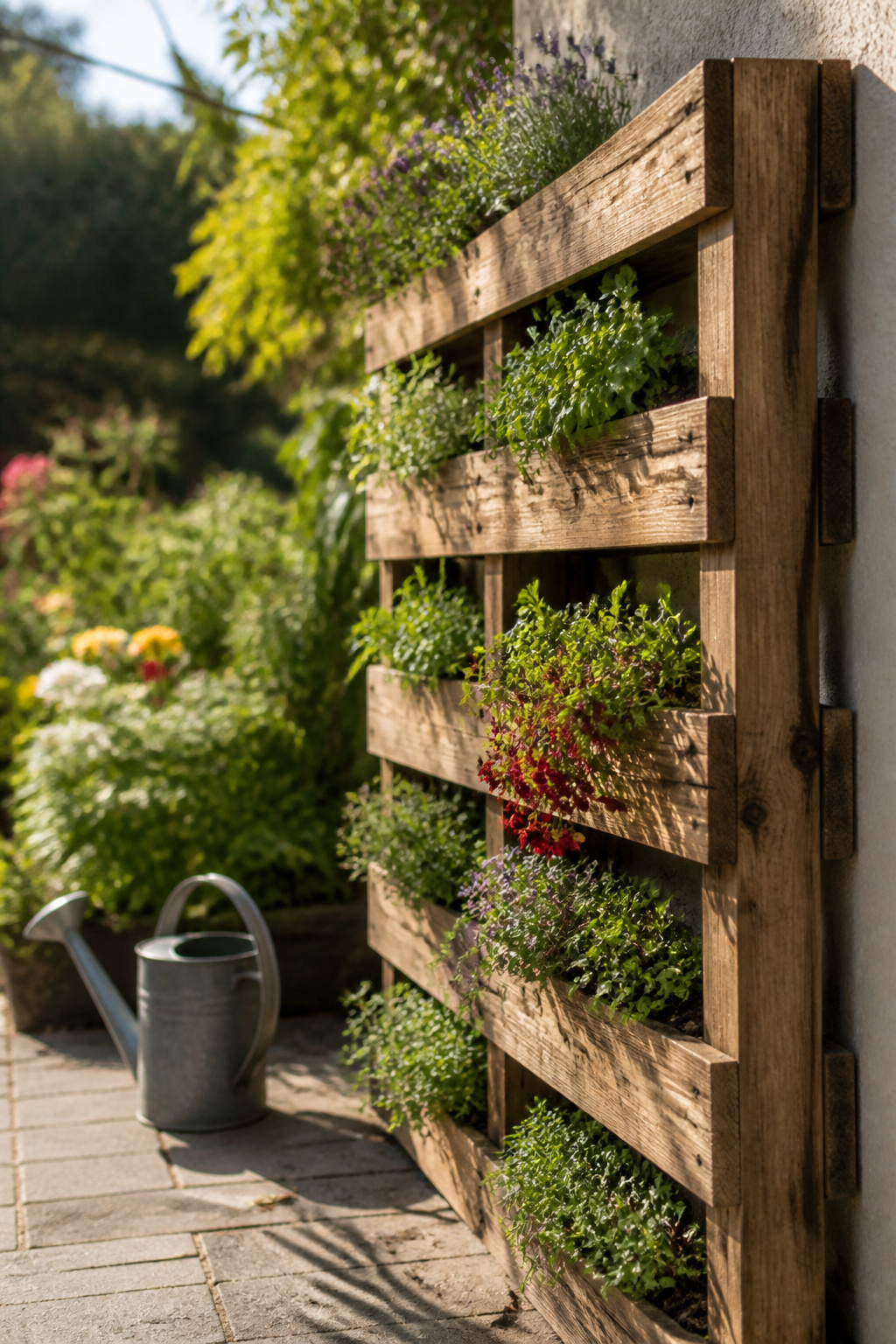
Pallets are the cheapest vertical frame you will find, and most garden centers or hardware stores will let you haul them away free. The catch is the wood treatment. Look for a stamp that reads HT, which means heat-treated, not MB for methyl bromide or a plain absence of marking that usually means chemical treatment. Heat-treated pallets are safe to plant in; the others can leach into your soil and into anything you eat.
Landscape fabric belongs behind the slats, stapled tight across the open back. I skipped this once and spent a season watching potting mix sift out every time I watered, until the whole structure was half empty and the roots behind it had nothing to hold. The fabric needs to run from the top rail to the bottom rail with no gaps, because the back of a pallet is not a solid wall; it is a ladder of spaces, and soil finds every one of them.
Some builders line the front slats too, but the back is the part that fails silently. Hose clamps or small pots screwed to the front slats work for herbs if you would rather not fill the whole bay with soil. Either way, a timed drip line threaded through the slats beats hand-watering for anything stacked more than shoulder high. DripWorks sells kits meant for exactly this kind of outdoor setup, and the timers matter more than the brand.
6. Succulent Wall Art

Succulent wall art starts with a shadow box or sturdy picture frame and a layer of wire mesh stretched across the opening. The mesh holds the roots in place while the frame hangs vertical, which matters more than you’d think: standard potting mix drains too slowly for this setup, so a well-draining cactus mix is the move here.
These need water more often than their reputation suggests. Drought-tolerant does not mean drought-proof, and a shallow frame dries out faster than any pot. I water mine when the soil at the mesh line feels dry, which in summer heat means roughly twice a week, not the spare monthly schedule people assume.
For filling in fast, sedums like Sedum acre and Sedum rupestre spread to cover gaps within a single season. Others, particularly the tighter rosette-forming sempervivums, sit nearly unchanged for months before they decide to offset. The difference matters if you want that living-mosaic look quickly versus watching bare wire for half the year.
7. Vertical Vegetable Garden

Vertical vegetable gardens turn the same square footage into more food because climbing varieties fill airspace bush varieties never touch. Vining tomatoes, cucumbers, and winter squash on sturdy trellises or cattle-panel arches keep fruit off damp soil and let you walk underneath. Bush beans and bush tomatoes stay low, which wastes the vertical room a wall garden is built for; they also mat together, trapping humidity and cutting the airflow that keeps leaves dry.
My pole beans on a seven-foot teepee in a four-by-four bed produced roughly three times what my bush beans managed in the same ground the year before. The pods hung in open air, easy to spot and pick, while the bush beans hid theirs in a tangle of leaves I had to part by hand. The difference was the height, not the soil.
Vertical gardening allows you to produce more food per square foot compared to traditional methods.
For a backyard wall or narrow side yard, that math matters. One warning from the same farm director: mature tomato and cucumber vines get heavy. Flimsy bamboo stakes lean and snap; use metal T-posts, cattle panels, or wood framed with lag bolts, and sink supports eighteen inches deep minimum. A loaded vine in August with fruit swelling daily will test whatever holds it.
8. Wall-Mounted Shelves for Pots
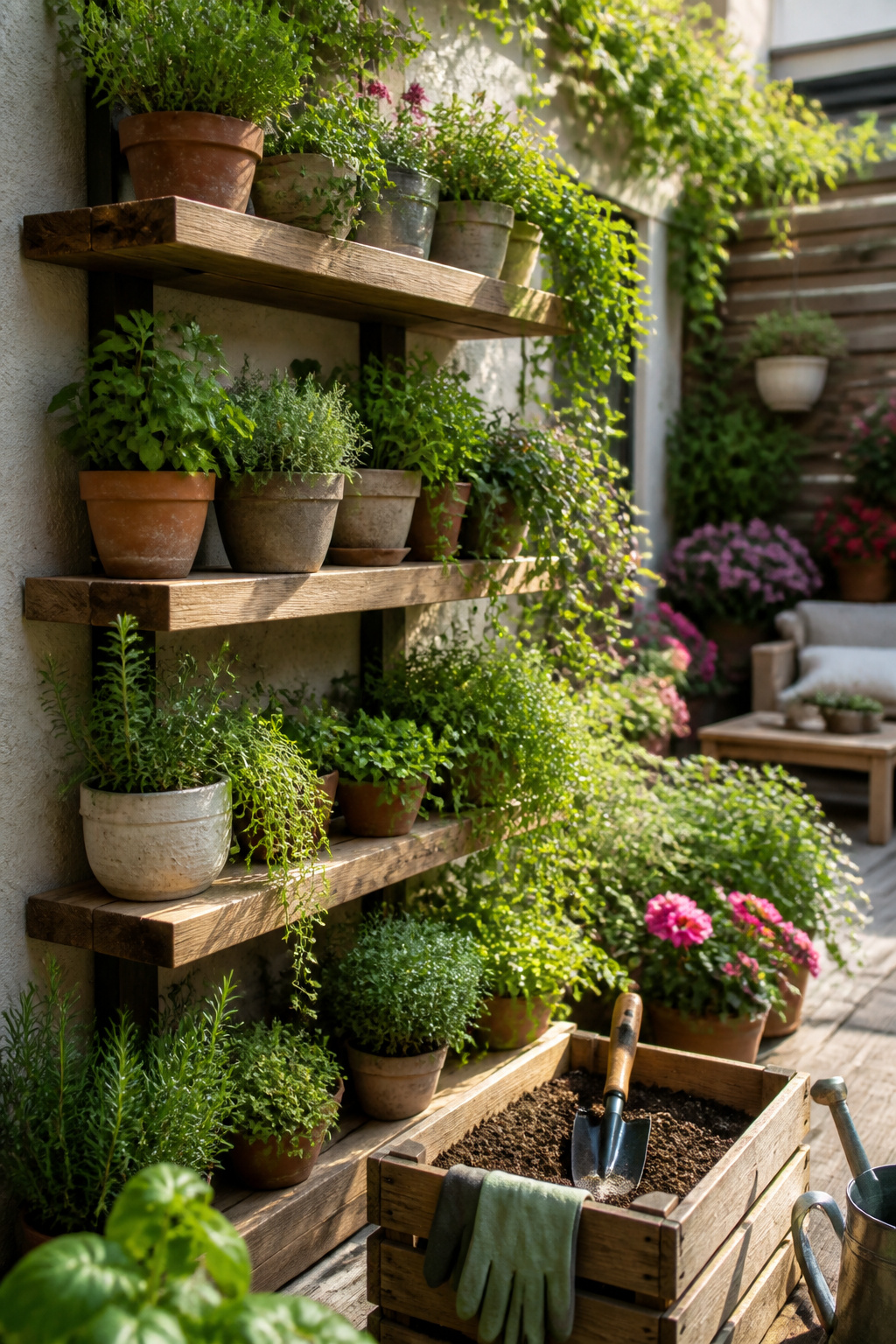
Wall-mounted shelves turn a blank fence into layered growing space, but the hardware matters more than the wood. Bracket ratings exist for a reason. I learned that the spring I hung a 15-pound ceramic pot on a pair rated for 10 each, thinking I had margin to spare. The lag bolt pulled out of the siding after three weeks of watering weight, and the pot shattered on the patio below. Check the bracket rating for the loaded weight, not the empty pot.
Staggered depths do more than look interesting. A flat grid of shelves at the same depth casts the lower rows into shade and crowds root zones; stepping them 6 to 10 inches apart front to back lets light reach each level and gives trailing plants room to spill without tangling. Acrylic shelves come in 1/4-inch or 3/8-inch thickness, with the thinner stock suited to plastic propagation trays and the thicker meant for ceramic or terra-cotta. The 3/8-inch panels include rear holes for cable pass-through and center markers engraved for aligning grow lights, which saves measuring twice and drilling wrong once.
9. Pocket Wall Garden
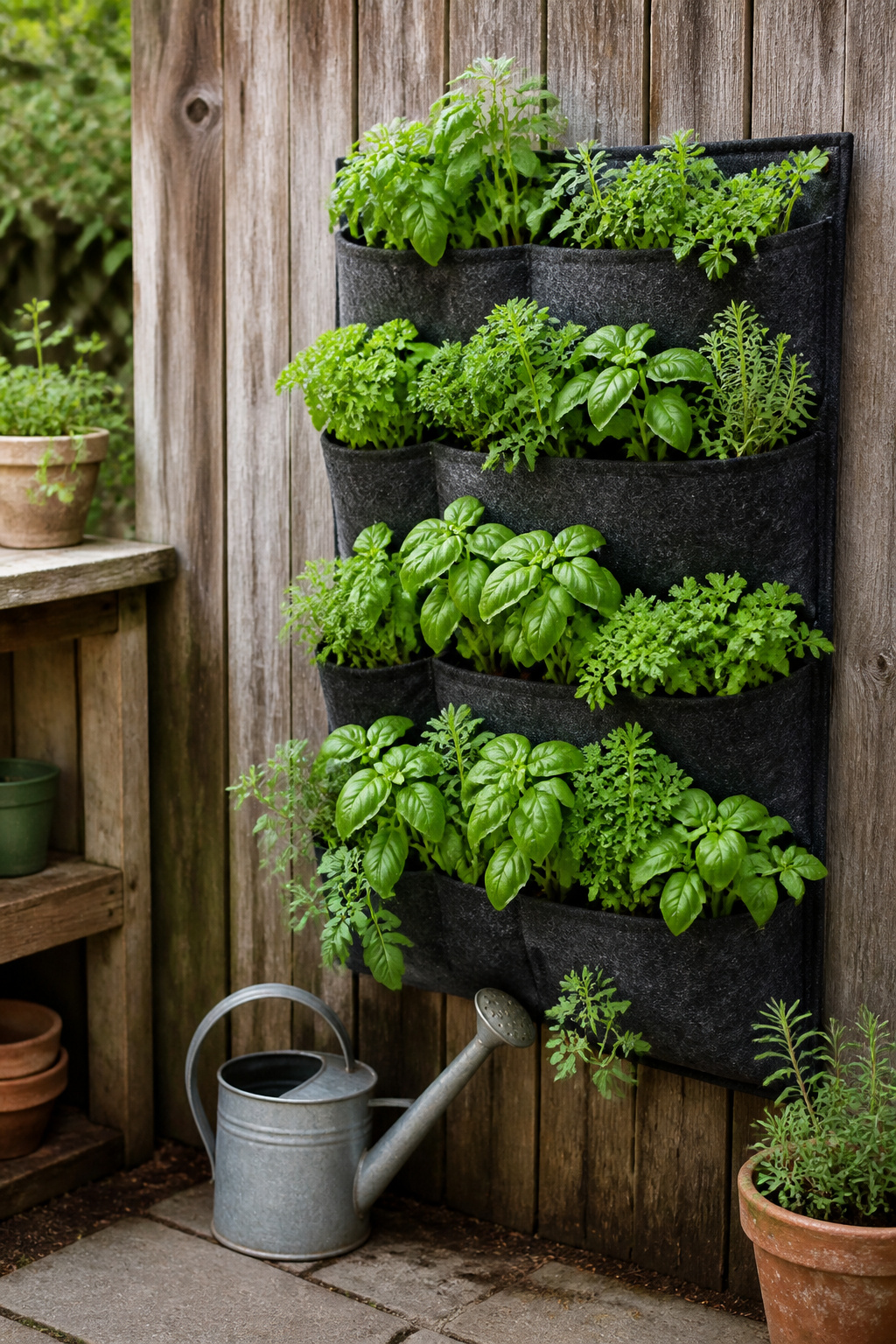
Felt pocket planters mount with screws and fill in minutes, which makes them tempting for a quick weekend project. The catch is compost in vertical pockets dries out faster than any other wall system I have seen, and I learned that the hard way. Three rounds of lettuce crisped to straw before I accepted that hand-watering every two days was not enough.
What changed the game was a simple drip line rigged across the top row. Gravity and capillary action do the rest, and now the pockets stay evenly damp instead of swinging between swamp and dust.
Not all pocket materials last. Thin felt bags sag and split by the second season. Structured fabric with reinforced seams and a rigid backing holds its shape through two years of full sun and freeze cycles. That rigidity also keeps root balls from compressing, which matters more than the catalog photos suggest.
Plant choice needs the same realism. Compact, drought-tolerant species survive these conditions. Delicate greens want the steadier moisture of a pallet box or a shelf system instead.
10. Vertical Strawberry Tower
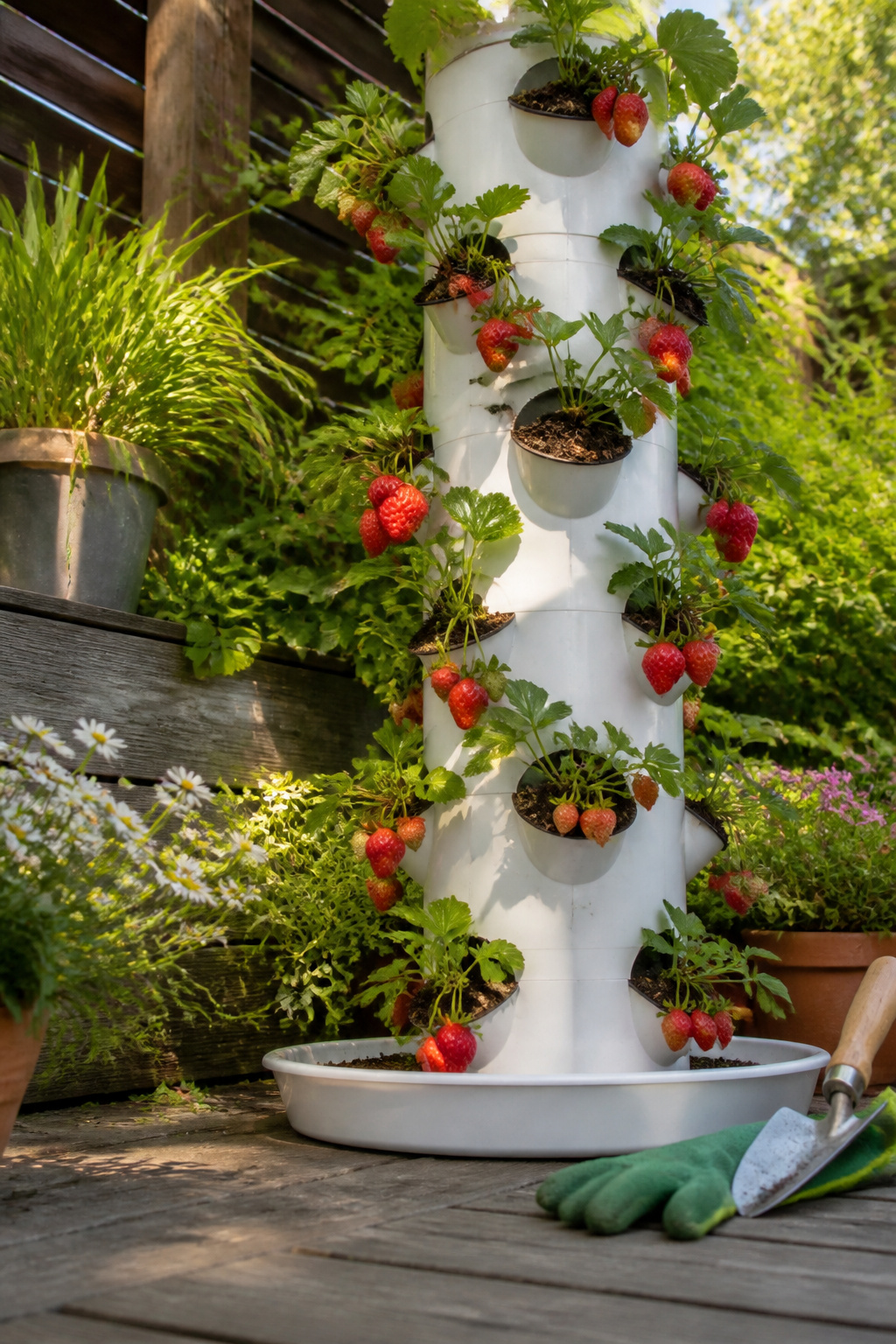
Strawberries on a wall need a tiered design, not a flat surface, because the runners that make ground-level beds so productive become the plant’s worst enemy there. In a traditional row, a runner touches soil and roots into a new daughter plant; on a vertical wall it hangs in air, dries out, and dies back into the crown. That rot risk is why I stopped trying to train flat-bed varieties upward and switched to a true tower instead.
Two builds dominate here. The PVC version uses a central pipe with staggered holes cut around it, filled with soil mix, and capped top and bottom so water flows through the core rather than washing straight out the sides. Stacked pots are simpler: five or six graduated planters seated one inside the next, each rim holding the one above it, so you fill and plant each tier separately. The pot stack costs less and needs no tools, but the PVC tower uses water more efficiently and the berries at the bottom actually ripen instead of sitting in shade.
I started with June-bearing varieties, the ones that throw one heavy crop in late spring, and that was the wrong call for a wall. They fruit all at once on the top tiers where I could reach, then spend the rest of summer sending runners into empty air while the lower levels sat bare. Everbearing or day-neutral types give smaller but steadier harvests through the season, which keeps every tier working and limits the runner problem to a manageable trim every few weeks. Switching to everbearing plants doubled my actual harvest from the same footprint, not because the plants are more productive but because the fruit stayed where I could use it.
Why Vertical Gardens Work

Wall space is often the only space left once a small yard, patio, or balcony has its table and its path. Vertical gardening grows out of that constraint rather than fighting it. The ten ideas that follow all share this logic: they treat a wall, fence, or bare structural face as growing room that costs nothing extra in footprint.
The benefits stack fast. Plants trained upward or mounted in pockets on a vertical surface can double or triple your usable growing area without touching the ground plan. Aesthetically, a green wall breaks up flat planes and softens hard lines; in tight urban settings like Brooklyn or any condo cluster, that living surface becomes the garden’s main event rather than its border. The air-quality effect is quieter but real: office studies with green walls have tracked measurable improvements in workers’ skin condition and immune markers, and the presence of plants demonstrably lowers stress markers, which is why living walls show up in spas and meditation studios.
Privacy and screening matter too. A vertical planting can hide an ugly view or create a focal point where the ground offers none. Gravity becomes a design tool rather than a problem; the wall holds the structure, and the gardener supplies the plants. That division of labor is what makes these projects workable on a $500–$800 annual budget and a single weekend’s effort.
Picking Plants for the Wall

Right plant, right place still applies when the place is vertical. Light at the wall is usually the limiting factor: a north-facing fence gets almost no direct sun, while a south-facing garage wall can bake root zones above 85°F by mid-afternoon. I have watched clematis sulk through South Carolina summers for exactly this reason, and the variety labeled full sun on the tag still prefers its roots cool and shaded by something at ground level.
Moisture needs must match across any shared planter or pocket system. Group sedums with succulents, ferns with ferns; a living wall dies from the inside out when one species wants daily misting and its neighbor rots in that much water. Root depth determines container choice. Shallow pouches suit sedums and small grasses. Climbing roses, wisteria, and trumpet vine need ground soil or deep boxes, plus a structure rated for their mature weight. Annual morning glories or black-eyed Susan vine ask less of a trellis than a mature wisteria that can pull a pergola joint loose.
Feeding runs on the same gradient. Slow-release granules at planting, then water-soluble through the season for heavy-blooming annuals and edibles. Succulents and ornamental grasses want less than half that frequency, or growth turns soft and prone to flop.
Watering and Upkeep

Vertical compost dries faster than the same depth sitting flat on the ground. The pocket planters I started with needed water every other evening by July, and by August that was not enough. Drip irrigation timed for early morning is what actually solved it, after I gave up on the watering can routine I had planned. My intended schedule was twice a week, deep and slow. The real schedule became daily drips at 6 a.m., with a hand check every Friday to feel whether the back pockets were staying wet.
Pruning matters more on a wall than in a bed because air does not move the same way against a fence. I cut my mini vines back harder than I expected in late spring, and that open structure kept mildew off the leaves. Drainage holes at the base of each pocket, not just the bottom row, kept roots from rotting in a week of rain. Replacing one plant at a time, as things failed, proved easier than the overhaul I feared.
Reading Your Wall Before You Build

A south-facing wall catches enough sun to ripen fan-trained fruit, which is why most guides point you there first. North-facing walls will grow gooseberries and a few shade-tolerant plants, but that orientation cost me a season of leggy seedlings and a pocket planter that stayed wet enough to grow mold on the back panel. The difference is not just light; it is how fast the compost dries and whether it dries at all.
Weight matters more than I expected. Stone or concrete can take the load of a seat wall topped with soil and mature plants, but a wood fence with a vertical planter needs you to stay honest about total pounds after watering. Check whether you can run drip irrigation from a hose bib; hand-watering a vertical garden gets old fast, and inconsistent moisture is what turns compact, drought-tolerant plants into stressed ones. A north-facing wall without drainage gaps and air space behind the pockets is a mold factory waiting to happen.
Privacy Screens and Indoor Options

Privacy screens and indoor systems sit at the edges of what most people mean by wall gardens, which is why they did not make my own list of ten. A dense screen of ivy rooted in planters at ground level, the way Folia Gardens builds them in New York, functions more like a living fence than a garden you tend. The climbing structure matters less than the cultivar’s willingness to fill it in, and the wall itself stays bare. For renters with a balcony, this is practical; for someone who wants to water and harvest, the plant choices narrow sharply.
Indoor hydroponic units like the Lettuce Grow Farmstand Nook flip the problem entirely. It holds twenty plants under full-spectrum LED lights, no soil, no outdoor wall required. The nutrient water does the work sunlight would, and herbs grow year-round. I see the appeal for apartment kitchens with no south window, but the unit price and the ongoing replacement of nutrient solution push it past what I would spend on a single season’s experiment. An indoor herb wall in soil, mounted in the kitchen, costs less and breaks down when you move. The hydroponic rig wins only if you are committed to vegetables rather than herbs, and committed long enough to amortize the buy-in.
Frequently Asked Questions
What plants grow well in vertical gardens?
Nearly any trailing or climbing plant can grow vertically, including perennial or annual vines, small perennials, sedums and succulents, ornamental grasses, ferns, annual flowers, edibles, and houseplants. For wall gardens specifically, compact and drought-tolerant species fare best in pockets and shallow containers, while climbing roses, wisteria, and clematis need deep boxes or ground soil and structures rated for their mature weight. Match moisture needs within any shared system: group sedums with succulents and ferns with ferns, or one species will rot while its neighbor dries out.
Can you grow vegetables in a vertical garden?
Yes. Vining tomatoes, cucumbers, winter squash, pole beans, and peas all climb well and produce more per square foot than bush varieties. Pole beans on a seven-foot teepee in a four-by-four bed yielded roughly three times what bush beans managed in the same ground. Use metal T-posts, cattle panels, or wood framed with lag bolts for supports, and sink them eighteen inches deep minimum; mature vines with swelling fruit get heavy fast and will test whatever holds them.
What are the benefits of vertical gardening?
Vertical gardening doubles or triples usable growing area without adding footprint, which matters when a small yard, patio, or balcony has no ground left to spare. A green wall breaks up flat planes and softens hard lines; in tight urban settings it becomes the garden’s main event rather than its border. The setup also screens ugly views, improves air quality, and lowers stress markers, which is why living walls show up in spas and meditation studios.